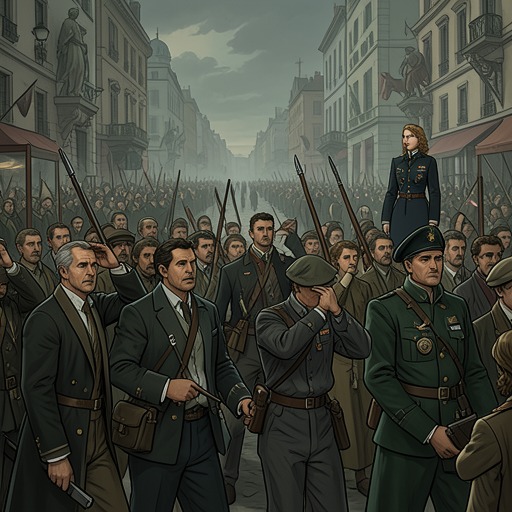
Nazi book burning in Molching
The Book ThiefNazi book burning in Molching is the central ritual of the town’s 1940 celebration of Adolf Hitler’s birthday: a public bonfire in which books, newspapers, posters, flags, and other condemned materials are gathered, displayed, and destroyed. Its decisive significance lies in the way the event converts political exclusion into communal entertainment. The fire does not merely consume paper; it presents the destruction of memory, dissent, and human complexity as a celebration of national unity.
Causes and Preparation
Molching’s celebration was organized in the context of World War II and the Nazi regime’s claim that Germany had overcome the restraints imposed after World War I. In 1940, Adolf Hitler’s birthday was to be made especially magnificent because the war had developed in Germany’s favor and Hitler’s position appeared victorious. The program promised a parade, marching, music, singing, and a fire, bringing political loyalty into the ordinary streets of the town.
The Nazi Party prepared the bonfire by collecting fuel throughout Molching. Party members went from door to door asking residents whether they possessed material that ought to be destroyed. The request printed in the Molching Express expanded the category beyond books to include newspapers, posters, flags, and alleged enemy propaganda, especially material associated with the period before the Nazi state. Even Schiller Strasse, known as the road of yellow stars, was searched again for something that could be burned in the Führer’s name. The language of collection made censorship appear voluntary and civic, although the atmosphere made refusal dangerous.
The ceremony also required visible participation. On the day itself, every window in Molching displayed the Führer’s emblem or a Nazi flag. Some flags were carefully presented, while others hung from ledges like laundry, but their presence mattered more than their appearance. The Hubermanns briefly could not find their own flag, and Rosa Hubermann feared that the authorities would come for them and take them away. The missing flag was eventually discovered behind Hans Hubermann’s accordion, a domestic object accidentally concealing the symbol that public loyalty demanded.
The Ceremony in the Town Square
Carts carried the collected material into the town square, where it was dumped into a mound and soaked with a sweet-smelling accelerant. Books and paper slid down the heap and were thrown back onto it. From a distance the pile looked volcanic, grotesque, and alien, as if something dangerous had landed in the center of Molching and needed to be extinguished. More than a thousand people crowded the square, the town hall steps, and the surrounding rooftops, turning destruction into a mass gathering.
Liesel Meminger entered the crowd as it gathered strength. The crackling she heard was not yet the fire but the movement of human beings charging themselves with expectation. Her view was blocked by a horizon of Nazi flags and uniforms. The crowd was presented as a single body: its members breathed together, sang together, and waited together for the flames. This arrangement erased individual judgment by making collective participation seem like the natural condition of belonging.
A uniformed man in a shiny brown shirt called for silence, then opened with the Nazi greeting and performed the salute to Adolf Hitler. The ceremony thus joined speech, gesture, clothing, and architecture into one political formula. The obligatory march around the grounds, the anthem, and the salute repeated the same lesson: national identity was to be enacted publicly and without hesitation. The bonfire was not an isolated act of destruction but the climax of a carefully rehearsed ritual of obedience.
The Burning
The speaker announced that the crowd was saying goodbye to “this trash, this poison.” A brownshirted official then accepted a torch, lit the mound, and repeated the Nazi greeting. The audience answered him, while other men surrounded the heap and added their flames. Voices, bodies, sweat, uniforms, and swastikas merged into a scene of approval. The crowd’s smiling participation made the violence appear festive rather than coercive.
The flames consumed paper and print, and the words were physically separated from the sentences that had carried them. What had been ordered language became smoke and ash. The fire therefore attacked more than objects: it asserted that the authorities could decide which meanings were legitimate and which could be erased. Beyond the heat, the spectators no longer appeared as distinct people but as brownshirts, swastikas, and signs. The event’s visual logic replaced persons with political markings.
For Liesel, the ceremony became a moment of nausea and recognition. She had come into the square surrounded by the symbols of collective German loyalty, but the fire exposed the brutality beneath their pageantry. Its public confidence did not make the act less destructive; it made the destruction more alarming, because thousands of people were invited to experience censorship as communal pleasure.
Historical and Narrative Context
The 1940 bonfire echoes the earlier ideological atmosphere that had shaped Nazi Germany before Liesel’s experience of the ceremony. The 1936 Olympic Games had already shown how Hitler’s regime used international spectacle, symbols, and racial ideology to manufacture national pride. Rudy Steiner’s admiration for Jesse Owens, whose achievements contradicted Nazi claims about racial superiority, revealed that official categories could not fully control individual perception. The later burning of books similarly attempted to close the gaps through which contrary knowledge might survive.
The event also belongs to a wider system of exclusion. After Kristallnacht, the Gestapo searched Hans Hubermann’s house and tolerated him partly because his application to join the Nazi Party remained pending. Later, his membership application was approved, bringing official belonging as a form of punishment rather than comfort. These circumstances clarify the bonfire’s social pressure: the town’s flags and salutes were not simply decorations or manners, but signs through which residents demonstrated that they belonged inside the sanctioned national community.
Against this official record stands the private record created by Liesel. While the state gathers and destroys books, she later uses a small paint can as a seat, a larger one as a table, and a pencil to begin writing The Book Thief. Her manuscript reverses the logic of the bonfire. The regime treats written language as disposable material when it conflicts with power; Liesel preserves experience by turning words into testimony. The fire’s attempt to erase memory thus becomes one of the conditions that make counter-memory necessary.
Consequences and Significance
Nazi book burning in Molching demonstrates how authoritarian power depends on ritual as much as on force. The parade, flags, anthem, salute, and repeated greeting create an imagined community in which participation feels like proof of moral legitimacy. At the same time, the event exposes the fragility of that unity: a household can fear punishment because a flag is missing, and a person can be tolerated or endangered according to the status of a party application.
The bonfire also establishes a central contrast in the story between official language and lived language. The authorities use slogans to classify enemies, celebrate victory, and name books as poison. Liesel encounters language differently: as something learned slowly, shared in relationships, and capable of preserving people whom the state would reduce to labels. The Nazi regime seeks control by narrowing what may be read and remembered; Liesel’s later writing answers by making a private archive from the lives threatened by that narrowing.
Its most enduring consequence is therefore interpretive rather than merely physical. The books are burned before a crowd that believes it is witnessing purification, but the scene reveals the moral corruption of the community performing it. Fire is presented as cleansing while it destroys thought; celebration is presented as unity while it depends on exclusion; the crowd appears powerful while surrendering individual judgment. The bonfire becomes a concentrated image of Nazi nationalism’s method: transform fear into ceremony, obedience into belonging, and cultural destruction into a public holiday.